
Do Ceramides Really Repair the Skin Barrier?
Ceramides are everywhere on ingredient lists these days, and the claims that follow them are getting louder: “repairs,” “restores,” “rebuilds the barrier.” The marketing is confident, but the science is more interesting than the slogans. A 40-year body of research does support what ceramides do for the outer layer of the skin. What it does not support is the idea that a single ingredient can undo years of damage in a week. If you have ever stood in front of a shelf wondering whether the cream with ceramides on the label is actually doing anything, this guide is for you. It walks through what the research actually shows, what “barrier repair” really means at a structural level, and where ceramides stop being useful and start being oversold.
What “Repair the Barrier” Actually Means
“Barrier repair” is one of those phrases that sounds simple until you try to define it. In dermatology, the skin’s barrier refers to the stratum corneum — the outermost layer of the epidermis, made of flat, dead skin cells called corneocytes. The stratum corneum has two jobs: keep water in, and keep irritants, microbes, and allergens out. When people say a product “repairs the barrier,” they usually mean one of two things:
- Helps the stratum corneum hold water better, so the skin feels less dry, tight, or flaky.
- Makes the skin less reactive to things that previously caused redness, stinging, or itchiness.
Both of these are real, measurable things. The question is whether ceramides — a family of lipids, not a single molecule — actually move the needle on either.
The Science: Where Ceramides Sit in the Skin’s Structure
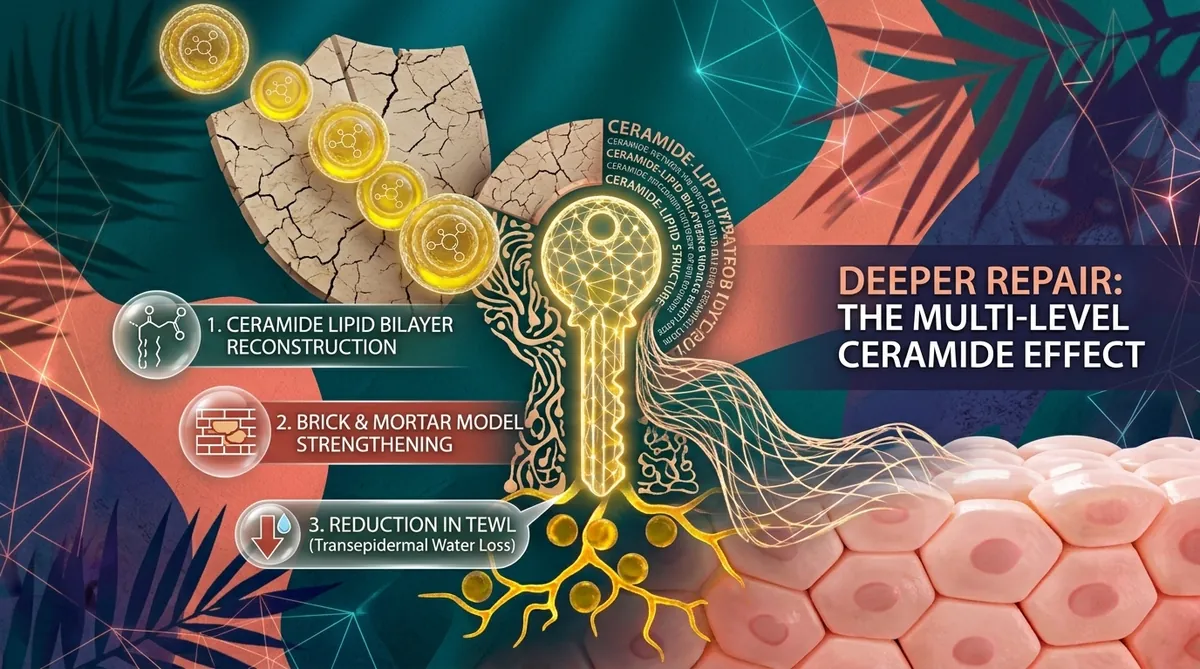
To answer that, you have to know where ceramides live. The stratum corneum is often described as a “brick and mortar” wall. The bricks are the corneocytes. The mortar is the intercellular lipid matrix — a thin layer of fat-like substances that fills the gaps between the cells and holds them together. This lipid matrix is roughly half ceramides (about 30–40% of its mass), with the rest split between cholesterol and free fatty acids. The three sit in an approximately equimolar ratio, and that ratio is what gives the matrix its ordered, layered structure.
When that structure is intact, water cannot easily escape through the skin, and outside substances cannot easily get in. When it is disrupted — by over-cleansing, harsh surfactants, cold dry air, UV, eczema, or simply aging — the skin loses water faster and becomes more reactive. Studies on atopic dermatitis and aged skin consistently show that ceramide levels in the stratum corneum drop significantly in both conditions, and the drop is most pronounced in the acyl-ceramide sub-fraction.
So the logic of putting ceramides back is structurally sound. The question is whether topical application actually delivers them where they need to go.
Two Core Functions Ceramides Perform
When formulated and delivered correctly, ceramides do two things that the research has reproduced many times over.
1. They help reduce transepidermal water loss (TEWL)
TEWL is the rate at which water passively evaporates through the skin. A healthy barrier keeps it low; a compromised barrier lets it climb. Multiple clinical studies have reported that formulas containing ceramides — especially when combined with cholesterol and free fatty acids in the right ratio — can reduce TEWL in dry, compromised, or aged skin over a period of weeks. The mechanism is not mysterious: the ceramides slot into the lipid matrix, fill some of the gaps, and reduce water escape. They do not add water; they slow its loss.
2. They help reinforce the skin’s tolerance to irritants
The second well-supported effect is on sensitivity and reactivity. In studies on subjects with sensitive skin, eczema-prone skin, or post-procedure skin (e.g., after retinoid initiation or chemical peels), ceramide-containing formulas have been shown to support a thicker, more orderly stratum corneum and reduce signs of irritation such as redness, stinging, and itch. The interpretation is straightforward: when the mortar between the bricks is healthier, fewer outside agents get through to the living layers below, so the inflammatory response is calmer.
These two functions — water retention and reactivity reduction — are the bulk of what the evidence supports. They are also, not coincidentally, exactly what “barrier repair” means to most people who reach for a ceramide product.
How Ceramides Are Formulated in Skincare
Raw ceramides are notoriously difficult to work with. They are poorly water-soluble, do not penetrate the skin easily, and tend to crystallize out of ordinary creams during storage. That is one reason cheap “ceramide” products do not always work — the ceramide in the jar is not necessarily the ceramide on your face. Modern formulations solve this with a few technologies:
- Liposomes and nano-vesicles that carry the ceramide into the upper layers of the stratum corneum.
- Microemulsions that keep the ceramide dispersed in a stable, skin-compatible vehicle.
- Pseudo-ceramides and synthetic analogs with similar structures but easier handling, often used to round out the formula cost-effectively.
- Multi-ceramide blends (combining NP, AP, EOS, EOP and others) to mimic the natural diversity of the skin’s own lipid matrix, rather than relying on a single type.
Clinical work in atopic dermatitis, ichthyosis, and sensitive-skin populations has used these delivery systems to show statistically significant improvements in TEWL, skin hydration, and tolerability over placebo or basic moisturizer controls. The magnitude depends on the formula, the skin condition, and the duration of use — but the direction is consistent.
The Honest Answer
So do ceramides really “repair” the skin barrier? The honest answer is: they support the structure that the barrier is made of, and the evidence for that is solid. They will not bleach hyperpigmentation, dissolve closed comedones, or replace a retinoid for collagen stimulation. They are not a cure for eczema, rosacea, or any disease — those need medical treatment. What they reliably do, when formulated and used consistently, is help the stratum corneum hold water better and stay calmer under stress. For a brand or formulator, that is genuinely useful: ceramides are one of the few topical ingredients where the in-vivo data, the mechanism, and the consumer-perceived result all line up.
If you are building a barrier-focused product line, ceramides belong in the formula. Just be clear about what they do, and what they do not.
Frequently Asked Questions
Do ceramides actually repair the skin barrier?
Topical ceramides help reinforce the lipid matrix of the stratum corneum, which supports the skin’s natural barrier function. They will not “heal” the skin in a medical sense, but clinical studies consistently show they reduce water loss and improve tolerance to irritants when used regularly.
How long does it take for ceramides to start working?
Most studies report measurable improvements in hydration and TEWL within 2 to 4 weeks of consistent use. The stratum corneum turns over roughly every 28 days, so give the formula at least one full cycle before judging it.
Can ceramides replace moisturizer?
Ceramides are usually part of a moisturizer, not a replacement for one. A ceramide without an emollient base will not feel comfortable on the skin, and a moisturizer without ceramide will not address the lipid matrix the same way. The two work together.
What is the difference between ceramide NP, AP, and EOP?
They are different molecular species of ceramide with different jobs in the stratum corneum. NP is the most abundant and supports water retention; AP is linked to corneocyte differentiation; EOP (also called ceramide 1) is an acyl-ceramide that helps stabilize the lipid layer’s lamellar structure. Most modern formulas combine several types for a more complete effect.
Can you use ceramides with retinol or exfoliating acids?
Yes. Ceramides are often paired with retinol, AHAs, and BHAs precisely because they help the skin tolerate those stronger actives. Apply the active first, then a ceramide moisturizer on top, to buffer the irritation without blocking the active’s effect.
Are ceramides safe for sensitive skin?
Yes — ceramides are among the best-tolerated actives for sensitive, eczema-prone, and post-procedure skin. They are lipids the skin already contains, so allergic reactions are rare. Look for fragrance-free formulas to avoid unnecessary irritants.
Ready to Build a Barrier-Focused Formula?
If you are developing a ceramide moisturizer, cleanser, lotion, or mask for a sensitive-skin or post-treatment line, MoCelie can help you move from sample to full production. We are an OEM/ODM skincare manufacturer based in Guangzhou, China, with a 15-person in-house R&D team, a 11,000 m² GMPC- and ISO 22716-certified facility, and a ceramide formulation library covering single-ceramide, multi-ceramide, and ceramide-plus-active systems.
MoCelie is a leading skincare manufacturer in sensitive-skin repair, acne-prone skin recovery, and anti-aging care in China. Our 15-person in-house R&D team develops new formulas together with Peking University, Guangdong Pharmaceutical University, and Southern Medical University, as well as the Chinese Academy of Sciences’ Zhuhai Institute and OuZheng Research Institute. We operate from an 11,000 m² facility with over 200 staff under GMPC and ISO 22716 certification — and our lab specializes in ceramide-driven barrier systems, ready to launch your ceramide skincare from sample to full production. Contact us to request a sample and a detailed quote.
Related guides: What Are Ceramides? The “Brick and Mortar” of Your Skin Barrier · Ceramide NP vs AP vs EOS vs EOP: The Precision Era of Barrier Repair
Explore our ceramide products: Ceramide Barrier Repair Cream-to-Foam Cleanser · Ceramide Daily Barrier Moisturizing Lotion