
What Are Ceramides? The “Brick and Mortar” of Your Skin Barrier
If the skincare world has a quiet workhorse, it is the ceramide. It does not promise overnight resurfacing or dramatic brightening. Instead, it does something more fundamental: it holds the skin’s outer wall together. For anyone choosing a moisturizer, cleanser, or serum — and for any brand deciding what to put in one — ceramides are worth understanding properly. Here is what they are, how they work, and why the “brick and mortar” analogy explains almost everything about them.
The Short Answer
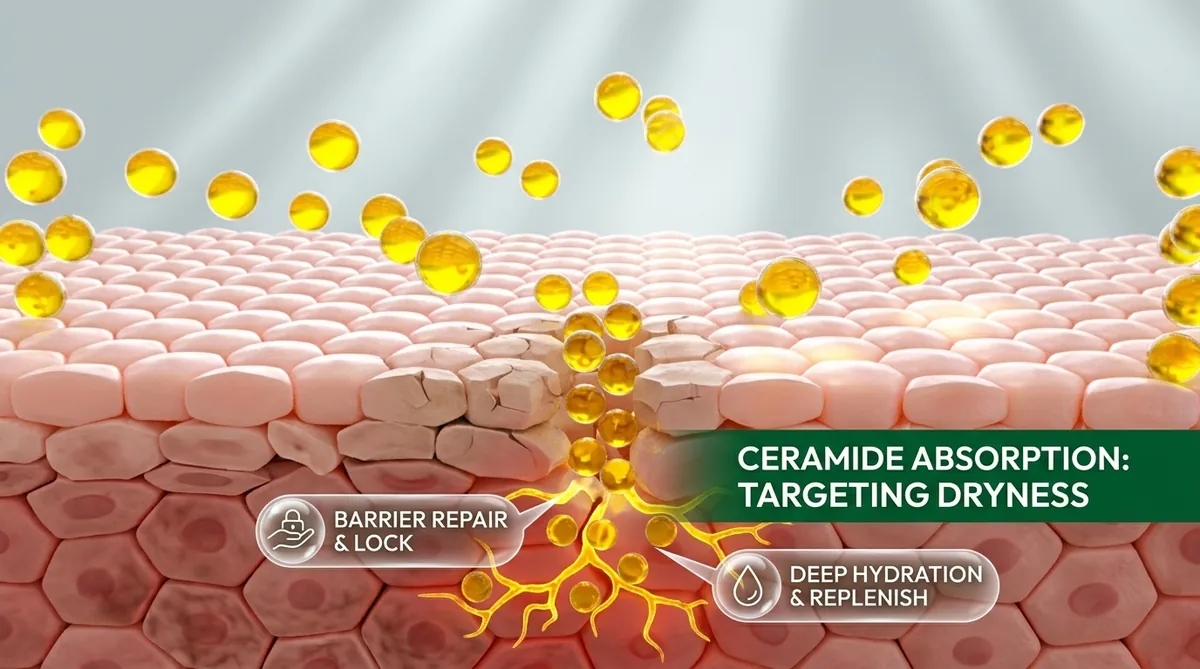
Ceramides are a family of lipid (fat) molecules that your skin produces naturally. They live in the outermost layer — the stratum corneum — and they are the main ingredient in the “glue” that keeps skin cells packed tightly together. In cosmetic formulas, ceramides are used to help reinforce that glue, which is why they are the standard active for barrier care.
The Skin Barrier, Explained in Bricks and Mortar
The clearest way to picture the skin barrier was introduced by researchers in 1983 and is still used today: the “brick and mortar” model.
- The bricks are corneocytes — flat, protein-rich cells that form the outermost surface of the skin.
- The mortar is the lipid mixture that fills the gaps between those cells and binds them together.
If the mortar thins out, the wall weakens. Water escapes more easily (dryness, tightness), and outside irritants find their way in more easily (redness, sensitivity). The single most important component of that mortar is the ceramide.
The intercellular lipids of the stratum corneum are roughly 50% ceramides, 25% cholesterol, and 15% free fatty acids. That 50% share is the reason ceramides — not just any oil or humectant — are the structural backbone of barrier function.
What Ceramides Are Made Of
A ceramide molecule has a distinctive two-part shape. One end is a sphingosine (or related) base, and the other is a fatty acid chain. This gives ceramides an amphiphilic character: one end is attracted to water and the other to oil. That is exactly what makes them so useful. Ceramides can arrange themselves, together with cholesterol and fatty acids, into the neat, layered sheets that make the barrier watertight — like shingles on a roof.
Why Ceramide Levels Drop — and What Happens When They Do
Ceramide levels do not stay constant over a lifetime. They decline with age, and they can be depleted faster by a few everyday factors:
- Aging — natural ceramide production slows over time.
- Harsh cleansing — strong surfactants or over-washing can strip the lipid mortar.
- Environment — low humidity, cold weather, and UV exposure add stress to the barrier.
- Over-exfoliation — aggressive acids or scrubs thin the outer layer and its lipids.
When ceramide levels fall, the classic signs follow: dryness, flakiness, tightness, and skin that reacts more easily to products it once tolerated. This is not a niche concern — a weakened barrier is one of the most common reasons people describe their skin as “sensitive.”
What Ceramides Do for Your Skin
Ceramides support the skin in a few connected ways, all of which trace back to the mortar:
- Barrier support — they help the skin hold water in and keep stressors out.
- Cohesion — they bind cells together, supporting a smoother-looking surface and reducing visible flakiness.
- Hydration — they form a network that helps trap moisture in the outer layer for longer-lasting hydration.
- Soothing — by reinforcing the barrier, ceramide-rich formulas help maintain comfort in dry or easily irritated skin.
Importantly, ceramides are not exfoliants and not stimulants. They are structural. That is why they work so well as the backbone of a gentle, daily-use routine rather than as a one-off treatment.
Where Ceramides in Formulas Come From
In skincare, ceramides are typically supplied as bio-identical or skin-mimicking lipid blends, often combined with cholesterol and fatty acids to mirror the skin’s natural ratio. For brands, the practical point is that “ceramide” on a label is not a single ingredient — it is usually a ceramide complex containing several types (such as Ceramide NP, AP, and EOP). A well-built complex outperforms a single isolated ceramide, which is why serious barrier products list a blend rather than one name.
Frequently Asked Questions
What do ceramides do for the skin?
They reinforce the skin’s outer barrier — the “mortar” between skin cells — helping the skin retain water, stay cohesive, and resist outside irritation.
Are ceramides the same as moisturizers?
Not exactly. Ceramides are a specific barrier-repairing lipid, while a moisturizer is the finished product. Many good moisturizers contain ceramides, but the ceramide itself is the active, not the whole formula.
Who should use ceramides?
Almost anyone, but especially people with dry, flaky, sensitive, or post-procedure skin, and anyone looking to keep their barrier strong as they age or exfoliate.
Can ceramides be used with actives like retinol or acids?
Yes. Ceramides are often paired with potentially irritating actives precisely because they help keep the barrier resilient while those actives do their work.
How long before ceramides make a difference?
Barrier support is gradual. The skin’s outer layer renews itself roughly every 28 days, so consistent daily use over several weeks is how most people notice the change.
Are all ceramide products the same?
No. Look for a multi-ceramide complex plus cholesterol and fatty acids, and check where the ceramides sit in the ingredient list — too far down usually means too little.
Ready to Formulate with Ceramides?
MoCelie is a leading skincare manufacturer in sensitive-skin repair, acne-prone skin recovery, and anti-aging care in China. Our 15-person in-house R&D team develops new formulas together with Peking University, Guangdong Pharmaceutical University, and Southern Medical University, as well as the Chinese Academy of Sciences’ Zhuhai Institute and OuZheng Research Institute. We operate from an 11,000 m² facility with over 200 staff under GMPC and ISO 22716 certification — and our lab specializes in multi-ceramide barrier formulas for cleansers, lotions, and creams. Contact us to request a sample and a detailed quote.
Related guides: Ceramides in Skincare: The Complete Guide · Ceramide NP vs AP vs EOP: The Precision Era · What Is PDRN in Skincare? · PDRN for Sensitive Skin