
Ceramides vs Peptides vs Hyaluronic Acid: What Each One Actually Does
Search “ceramides vs peptides” and you will find a hundred articles ranking them against each other, as if they were three athletes competing for the same trophy. They are not. Ceramides, peptides, and hyaluronic acid belong to three completely different functional categories, and treating them as interchangeable is the single most common mistake made by both shoppers and product developers. One is a structural lipid that the skin is physically built from. One is a signaling molecule that tells skin cells what to do. One is a humectant that grabs and holds water. This guide breaks down what each one actually does, where the evidence is strong versus thin, how the three behave when they share a formula, and why the order in which you address them matters more than the concentration on the label.
The Short Answer: Three Ingredients, Three Jobs
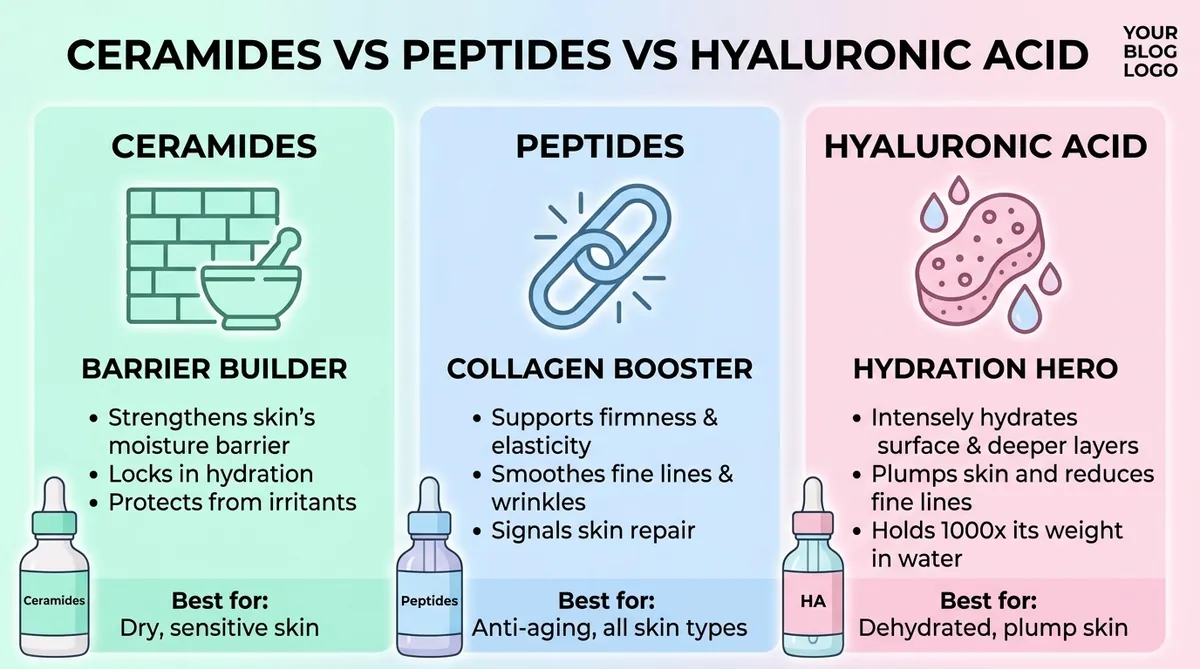
The confusion starts with the category label. All three get filed under “active ingredients,” which implies they compete for the same result. In reality they operate at different levels of the skin and in different physical roles:
- Ceramides are structure. They are lipids that form part of the intercellular matrix in the stratum corneum — the mortar in the “brick and mortar” model of the skin barrier. Their job is to hold the barrier together and slow water loss.
- Peptides are signals. They are short chains of amino acids that act as messengers, telling skin cells to produce more collagen, elastin, or other structural proteins. They do not become the structure; they instruct the cells that build it.
- Hyaluronic acid is water management. It is a glycosaminoglycan that binds large amounts of water and holds it in the skin. It does not signal and it does not build — it hydrates.
A useful analogy: think of the skin as a building. Ceramides are the mortar between the bricks. Peptides are the instructions handed to the construction crew. Hyaluronic acid is the water supply that keeps the materials workable. You cannot replace one with another, and a shortage of any of them shows up differently.
Ceramides: The Structure of the Barrier
Ceramides are a family of sphingolipids — fat-like molecules built from a long-chain base and a fatty acid. They are the single most abundant lipid class in the intercellular matrix of the stratum corneum, sitting alongside cholesterol and free fatty acids in a carefully balanced ratio. Not all ceramides are interchangeable, either: the individual types (NP, AP, EOS, EOP) have distinct roles, which we cover in our guide to the different ceramide types. That ratio is not decorative. The three lipids self-assemble into the ordered, layered sheets that give the barrier its property of being permeable to almost nothing.
Because they are structural, the benefit of ceramides is measured the same way you would measure a roof: by how much water escapes through it. Clinical work in dry, compromised, and atopic skin repeatedly reports that ceramide-containing formulas help reduce transepidermal water loss (TEWL) and support the skin’s tolerance to irritants. What they will not do is firm skin, fade pigment, or smooth expression lines — those are not structural problems.
Two practical notes matter more than the marketing suggests. First, the ratio matters: ceramides work best alongside cholesterol and fatty acids, not alone, and a formula that stacks ceramides without those partners is not automatically better. Second, ceramides are slow and cumulative. The stratum corneum renews over roughly four weeks, so a single application tells you almost nothing about whether the formula is working. If you want the underlying evidence in more detail, we reviewed it in do ceramides really repair the skin barrier.
Peptides: Signals, Not Building Blocks
A peptide is simply a short chain of amino acids — long enough to carry information, short enough to be stable and to penetrate past the outer layer. In skincare they are usually sorted by the message they carry:
- Signal peptides prompt fibroblasts to increase production of collagen and elastin — the long-term structural work behind firmness and elasticity.
- Carrier peptides deliver trace elements such as copper to enzymes involved in repair and remodeling.
- Neurotransmitter-inhibiting peptides (often called neuropeptides) work differently — they target the muscle-contraction signaling behind expression lines, with a much faster visible timeline.
- Enzyme-inhibitor peptides interfere with the enzymes that break down collagen, supporting the matrix indirectly.
This is where realistic expectations matter. Peptides are potent at very low concentrations — often in the parts-per-million range — but their results are slow. Signal peptides are typically evaluated over three to six months, not weeks, because they change what cells produce rather than what the surface looks like. Neuropeptides are the exception, with visible effects on expression lines in a matter of weeks.
There is also a regulatory dimension that brands cannot ignore. “Peptide” is a broad term, and not every peptide is the same molecule. Oligopeptide-1 — a simple three-amino-acid chain — is often confused with human oligopeptide-1, better known as EGF, a 53-amino-acid growth factor that is not permitted in cosmetic formulations in China and requires careful positioning in North America. Marketing a formula as “peptide-powered” without specifying which peptide is not just vague; in some markets it is a compliance risk.
Hyaluronic Acid: Water Held at Different Depths
Hyaluronic acid (HA) is a glycosaminoglycan — a long sugar polymer made of repeating glucuronic acid and N-acetylglucosamine units. It is not a foreign substance: roughly half of the HA in the human body is found in the skin, where it contributes to hydration, barrier integrity, and the viscoelastic properties of the extracellular matrix. Its defining chemical feature is an extremely high density of hydroxyl and carboxyl groups, which form hydrogen bonds with water and let a single molecule hold a large multiple of its own weight in moisture.
The part most people miss is that molecular weight determines where HA acts, and the three size ranges behave almost like different ingredients:
- High molecular weight HA is too large to penetrate. It stays on the surface, forming a breathable hydrating film that improves the immediate feel of the skin and helps reduce water loss.
- Medium molecular weight HA works within the stratum corneum, maintaining the hydration gradient through the upper layers and providing longer-lasting moisture.
- Low molecular weight and oligomeric HA can travel further into the epidermis and even the dermis, where it interacts with CD44 receptors on keratinocytes and fibroblasts and supports the skin’s own HA synthesis and cell renewal.
This is why nearly every serious formula uses a blend of multiple molecular weights rather than a single grade — a high-molecular-weight film on top, medium weights holding the middle, and low or oligomeric fractions reaching deeper. It also explains a counterintuitive caveat: humectants attract water from wherever it is available, so in very dry environments a high-concentration HA formula without an occlusive partner can pull moisture out of the skin rather than into it. Water always needs something to hold it in place.
Which One Do You Actually Need?
Since the three ingredients solve different problems, the useful question is not “which is strongest” but “what am I trying to fix.” A quick decision framework:
- Skin feels tight, dry, reactive, or stings when you apply almost anything — this is a barrier problem. Prioritize ceramides with cholesterol and fatty acids.
- Skin looks less firm, lines are deepening, texture is changing slowly — this is a structural protein problem. Prioritize signal peptides, and give them months, not days.
- Lines that appear with movement — forehead, crow’s feet, nasolabial folds — consider neuropeptides, which act on a faster timeline.
- Skin looks dull, feels rough or “dehydrated” but not necessarily inflamed — this is a water problem. Prioritize multi-molecular-weight hyaluronic acid with an occlusive base.
In practice, most people have more than one of these issues at once, which is exactly why the “pick one” framing falls apart. A dehydrated barrier and a loss of firmness are not competing complaints; they are two separate systems that need two separate solutions in the same routine.
Why Barrier Comes First
If there is one principle worth carrying away from this comparison, it is that a compromised barrier degrades the performance of everything else. The stratum corneum is the gatekeeper. When its lipid matrix is intact, water stays in and irritants stay out — and actives applied on top have a stable environment to work in. When it is disrupted, TEWL climbs, reactivity rises, and the skin’s tolerance for anything even mildly stimulating drops.
That is why formulators who specialize in sensitive and compromised skin tend to treat ceramides as infrastructure rather than as a headline active. Adding a signaling peptide or a high-performance humectant to a skin that cannot hold water or tolerate stimulation is like installing a smart thermostat in a house with a hole in the roof. The sequence is not about which ingredient is more important — it is about which environment lets the others function.
How the Three Work Together in One Formula
Because they operate on different systems, ceramides, peptides, and hyaluronic acid coexist in the same product unusually well. There is no meaningful conflict between them — no pH clash, no absorption competition of the kind that forces brands to separate retinoids and acids. A well-architected barrier formula often contains all three at once: ceramides rebuilding the lipid matrix, hyaluronic acid supplying and holding water, and a peptide blend providing the long-term structural signal.
This is the logic behind what formulators call a “1 + N” architecture: one core active defines the product’s identity, and a set of supporting ingredients — humectants, lipid partners, soothing agents, peptides — make sure that core active can actually perform. The single-ingredient hero narrative sells well in marketing, but it is rarely how the best-performing formulas are built. When we develop a barrier or anti-aging product for a brand, the conversation almost always starts with the barrier infrastructure and moves outward from there. (We go deeper into pairing strategies in our complete ceramide guide.)
Frequently Asked Questions
Can I use ceramides, peptides, and hyaluronic acid together?
Yes. The three work through different mechanisms and do not interfere with each other, which is why they frequently appear in the same serum or moisturizer. Many well-designed formulas combine all three: ceramides for the lipid matrix, hyaluronic acid for hydration, and peptides for long-term structural signaling.
Which is better for anti-aging, peptides or ceramides?
They address different parts of aging. Peptides signal skin cells to produce more collagen and elastin, which relates to firmness over time. Ceramides support the barrier and reduce water loss, which relates to how smooth and resilient the surface looks. Most anti-aging routines benefit from both rather than choosing between them.
Is hyaluronic acid enough on its own as a moisturizer?
Not usually. Hyaluronic acid is a humectant — it attracts and holds water but does not seal it in. Without an emollient or occlusive ingredient to reduce evaporation, it can leave skin feeling dry again quickly, and in very dry climates it may even draw moisture away from the skin. Pair it with a lipid-rich moisturizer, ideally one containing ceramides.
Do peptides actually work, or is it just marketing?
Specific peptides have real, measurable mechanisms — signal peptides influence collagen synthesis, and neuropeptides affect muscle-contraction signaling. The catch is that results take time and depend on the peptide, its concentration, and the delivery system. Formulas that name the exact peptide and pair it with a supporting base are generally the ones worth evaluating seriously.
What should I apply first, a peptide serum or a ceramide moisturizer?
As a general rule, apply the lighter, more targeted product first and the richer, more occlusive product last: a peptide or hyaluronic acid serum, then a ceramide moisturizer to seal it in. This order lets the water-binding and signaling ingredients sit close to the skin while the lipid layer slows evaporation on top.
If I am launching a new skincare product, which of the three should I build around?
Start from the consumer problem, not the ingredient trend. Barrier-related complaints point toward a ceramide-led formula; firmness and lines point toward a peptide-led one; dullness and dehydration point toward a hyaluronic-acid-led one. The strongest products pair a clear lead active with supporting ingredients that make it work, rather than stacking actives for a longer ingredient list.
Ready to Build a Formula Around the Right Actives?
If you are developing a barrier repair, anti-aging, or hydration product and want to get the architecture right from the start, MoCelie can help you move from sample to full production. We are an OEM/ODM skincare manufacturer based in Guangzhou, China, and our formulation library covers ceramide systems, multi-peptide complexes, and multi-molecular-weight hyaluronic acid matrices, along with the delivery technologies that make each of them perform in real conditions.
MoCelie is a leading skincare manufacturer in sensitive-skin repair, acne-prone skin recovery, and anti-aging care in China. Our 15-person in-house R&D team develops new formulas together with Peking University, Guangdong Pharmaceutical University, and Southern Medical University, as well as the Chinese Academy of Sciences’ Zhuhai Institute and OuZheng Research Institute. We operate from an 11,000 m² facility with over 200 staff under GMPC and ISO 22716 certification — and our lab specializes in ceramide, peptide, and humectant systems, ready to launch your skincare line from sample to full production. Contact us to request a sample and a detailed quote.
Related guides: What Are Ceramides? The “Brick and Mortar” of Your Skin Barrier · PDRN vs Peptides: Which Active Is Right for Your Skincare Brand?
Explore our ceramide and peptide products: Ceramide Daily Barrier Moisturizing Lotion · Peptide Collagen Firming Facial Lotion