Recombinant Collagen Serum Private Label: The Complete Guide for Skincare Brands
Collagen is the word consumers already associate with firm, youthful-looking skin — but the collagen ingredients behind most early “collagen creams” came from animal hides, fish scales, and pigskins, processed with acid-alkali extraction that left residues and never quite matched human protein sequences. The category was ripe for a reset, and recombinant collagen is that reset: a protein produced through microbial fermentation, whose amino acid sequence can be matched to human collagen with precision, with no animals and no acid processing in the chain.
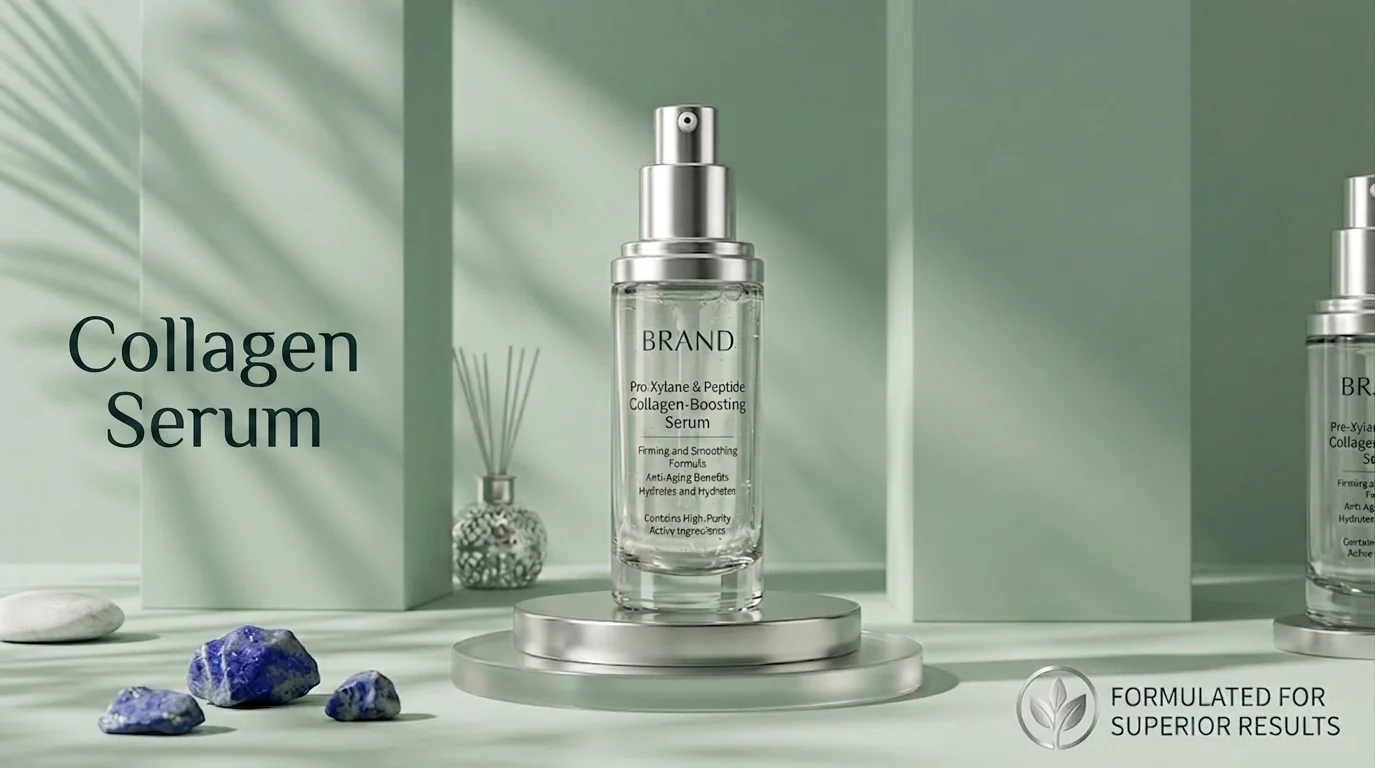
For independent skincare brands, the serum format is the most direct route to market. A serum carries a high payload of active ingredient in a lightweight vehicle, layers cleanly under moisturizer and SPF, and supports premium pricing without the overhead of a full cream line. This guide walks through the opportunity, the science, and the practical private label process — from concept and sampling to trial batches, packaging, and choosing the right factory partner.
Why a Recombinant Collagen Serum Now
The timing argument has three layers, and each one matters for a brand deciding what to launch next:
- The technology has matured. Recombinant collagen is no longer a lab curiosity. Engineered microorganisms — typically yeast strains like Pichia pastoris or bacteria like E. coli — now express collagen genes at commercial scale, with batch-to-batch consistency that animal extraction could never deliver. Industry analysis projects the recombinant collagen category growing from roughly 18.5 billion RMB in 2022 to over 100 billion by 2027 — a trajectory that mirrors what hyaluronic acid went through a decade ago.
- The animal-collagen story has stalled. Bovine, porcine, and marine collagen still dominate mass-market products, but they come with baggage: variable batch quality, potential immune responses, pathogen-related risks, and the simple fact that animal protein sequences never perfectly match human ones. Recombinant collagen sidesteps every one of these issues.
- Consumers are searching for it. “Collagen” has decades of consumer education behind it — the word itself signals anti-aging and firmness. Recombinant collagen lets a brand inherit that awareness while upgrading the science, and the “fermentation-derived, bio-identical, vegan” positioning works across clean beauty, science-forward, and sustainability-focused brand identities.
If that arc feels familiar, it should. Hyaluronic acid followed nearly the exact same path: a clinical-grade ingredient that crossed into consumer skincare, scaled through biotech fermentation, and became a category-defining staple. Recombinant collagen sits at that same crossover moment right now.
What Recombinant Collagen Brings to a Serum
Roughly 30% of the human body’s protein is collagen. In skin tissue specifically, collagen accounts for about 70% of the dermal layer, creating the fibrous architecture that gives skin its bounce, density, and structural integrity. The aging process begins eroding this network around age 25, with an estimated 1-1.5% annual decline — and Type III collagen (the finer, more elastic variant associated with youthful skin) drops off even more steeply than Type I.
Recombinant collagen lets a brand put a bio-identical version of that protein into a serum without the compromises of animal sourcing. Three properties make it particularly well suited to a leave-on concentrate:
- High concentration without dilution. Creams and lotions dilute actives behind emollients and thickeners. A serum delivers a meaningful payload of functional ingredient in a lightweight vehicle — which matters when your hero ingredient is a protein you want consumers to associate with visible results.
- Texture that fits any routine. Recombinant collagen serums can be formulated as thin essences, gel-serums, or slightly milky boosters. All of them layer cleanly under moisturizer and SPF, meaning consumers do not need to restructure their existing routine to add your product.
- A clean vegan story. Because it is produced through microbial fermentation — not extracted from animal tissue — recombinant collagen is compatible with vegan and cruelty-free brand positioning. That is a claim animal-derived collagen cannot make.
Serums also layer well with other actives. Recombinant collagen pairs naturally with hyaluronic acid (hydration layering), peptides (signaling support), Pro-Xylane (dermal matrix), and rare ginsenosides (cellular vitality) — so a serum lets you build a multi-active formula without the texture trade-offs that creams impose.
Type I vs. Type III: Which Collagen for Your Serum?
Choosing a collagen type is one of the earliest decisions in development, and it directly shapes what your serum claims to do:
- Type I collagen dominates adult skin, making up about 80% of dermal collagen content. Its fibers are thick and rope-like — the structural steel of the dermis. If your brand’s message is about firmness, density, and fighting the visible collapse of facial contours, Type I is your anchor ingredient.
- Type III collagen is the other major player. Its fibers are thinner, softer, and more elastic. In newborns, the Type I-to-Type III ratio sits near 1.5:1. By the time someone reaches 40, that ratio has typically widened to 5:1 or worse. This is why Type III earned the nickname “baby collagen” — its abundance correlates with the plump, injury-resistant, fast-healing skin of early life. If your serum targets early signs of aging, texture refinement, or sensitive-skin recovery, Type III is the more fitting choice.
- Dual-collagen serums. A growing number of brands refuse to choose. Combining Type I and Type III in one formula lets you address structural firmness and elastic softness simultaneously — and creates a richer ingredient story for packaging and marketing, without requiring two separate products.
Type IV collagen is also gaining attention for its role at the dermo-epidermal junction (the basement membrane zone). A handful of brands have begun incorporating it for barrier-level repair claims, though the clinical evidence base is still maturing.
The Formula Story: Hydrate, Barrier, and Firm in One Bottle
The strongest recombinant collagen serums are rarely single-ingredient products — they pair collagen with complementary actives that address different parts of the “why skin looks less firm” story. One proven direction is a barrier-and-firmness serum that combines collagen with three complementary ingredients:
| Element | Role in the formula | What it does |
|---|---|---|
| Recombinant Collagen | Core protein active | Forms a breathable film that locks in moisture and reinforces the skin’s barrier |
| Hyaluronic Acid | Hydration | Attracts and holds moisture for a smooth, plumped appearance |
| Peptide Complex | Signaling support | Helps skin look firmer and more resilient over time |
| Panthenol (Pro-Vitamin B5) | Soothing support | Calms the look of redness and supports barrier comfort |
This combination addresses three things at once: surface hydration and barrier film-forming (collagen), moisture plumping (hyaluronic acid), and signaling support (peptides). That is what makes it a credible “barrier + firmness” serum rather than a single-active novelty — and it positions well for sensitive-skin customers who want anti-aging benefits without irritation.
A typical product concept built on this thinking:
Product concept: Recombinant Collagen Firming & Barrier Serum
- Key ingredients: Recombinant Collagen (Type I or dual Type I/III), Hyaluronic Acid, Peptide Complex, Panthenol
- Format options: airless pump bottle, glass dropper, or single-dose ampoule
- Positioning: daily barrier-supporting and firming care
- Selling points: supports the skin’s collagen network, intensively hydrates and reinforces the moisture barrier, helps skin feel firmer and look more resilient, and offers gentle anti-aging care suitable for sensitive skin
The Molecular Weight Question Every Collagen Brand Must Answer
Here is a fact that many collagen marketing materials gloss over: full-length Type I collagen weighs in at roughly 280,000-300,000 Daltons. The threshold for passive penetration through intact stratum corneum — the skin’s outer barrier — sits around 500 Daltons. That gap is not marginal. It is roughly 600-fold.
What this means in practice:
- Full-length collagen applied to healthy, intact skin acts primarily as a film-former and humectant. It creates a breathable layer on the surface that locks in moisture and reinforces the barrier. Useful? Yes. The same as rebuilding dermal collagen from a bottle? No.
- Hydrolyzed collagen peptides (molecular weight in the 2,000-10,000 Dalton range) can partially enter the upper epidermis. They may support surface hydration and contribute to barrier function, but robust clinical evidence for structural dermal rebuilding through topical application remains thin.
This is not an argument against collagen serums — it is an argument for honest claims. The defensible, consumer-felt benefits of a topical recombinant collagen serum are surface hydration, barrier reinforcement, and protective film-forming. For cosmetic marketing, stick with phrasing like “supports the skin’s collagen network,” “helps skin feel firmer and look more resilient,” or “intensively hydrates and reinforces the moisture barrier.” Resist the temptation to claim dermal collagen regeneration unless you have the clinical data to back it up.
Three Generations of Collagen Technology
The sourcing path you select changes your cost structure, your regulatory options, and your brand narrative. Three generations of collagen technology currently coexist:
- Generation one — animal-extracted collagen. Sourced from bovine, porcine, or marine tissue. Still the most affordable option and still widely used in mass-market products. The trade-offs are real: variable batch quality, potential immune reactivity, acid-processing residues, and an increasingly dated brand story as consumers shift toward bio-tech and clean beauty.
- Generation two — fermentation-produced recombinant collagen. The collagen gene is inserted into a microbial host (yeast or bacteria), which then expresses the protein during fermentation. This is the current industry standard in the recombinant collagen sector. Benefits include high purity, batch-to-batch consistency, no animal-derived material, and the ability to design the amino acid sequence to match human collagen exactly. This is the sourcing route most brands should default to.
- Generation three — designed-domain collagen. Rather than manufacturing the full collagen molecule, this approach targets specific functional regions — cell-adhesion sequences, signaling motifs, or structural domains. The result is a more targeted ingredient: instead of “collagen,” you get “the part of collagen that does X.” Some producers have built composite systems blending multiple collagen types and functional fragments, marketed as “Human-like” bionic collagen.
The sourcing decision ripples into every part of your product. Fermentation-derived and designed-domain collagen both support vegan positioning and deliver consistent quality. The primary trade-off is price: recombinant collagen commands a premium over animal-derived equivalents. In markets where consumers are unfamiliar with the technology, you may also need to invest in education.
Step 1: Define Your Serum Concept
Before you brief a factory, decide what your recombinant collagen serum is:
- Collagen type plan. Type I, Type III, or a dual-collagen approach — each speaks to a different consumer concern.
- Sourcing preference. Fermentation-derived (standard) or designed-domain (advanced), and whether vegan certification matters for your brand.
- Texture direction. A watery essence, a gel-textured serum, a viscous ampoule, or a milky emulsion — each appeals to a different consumer profile and requires different formulation strategies.
- Packaging concept. Airless pump, glass dropper, or single-dose ampoule. Protein-based actives benefit from airless pump dispensers, which minimize oxidation and contamination risk.
- Claim language. Map out what you can and cannot say in your target markets before the formula is locked. Phrasing like “supports skin’s natural collagen,” “visibly improves firmness,” and “strengthens the moisture barrier” are defensible in most jurisdictions. Medical, repair, or treatment-style claims carry regulatory risk in the US, EU, and many Asian markets.
Step 2: Brief the Formula
Your manufacturer’s lab needs a clear direction, not a finished formula. Bring these decisions to the first call:
- Collagen type and production route. Confirm that your factory can source fermentation-derived recombinant collagen (not all factories have established supply relationships with biotech producers). Request the raw material supplier’s certificate of analysis and any supporting safety or efficacy documentation up front — a credible manufacturer will provide this willingly.
- Target concentration. Collagen does not follow a “more equals better” logic. The appropriate inclusion level depends on the raw material spec, the overall formula, and stability considerations. Ask the R&D team for their recommended range based on experience with similar formulations.
- Active pairings. A focused formula with three to four complementary actives generally outperforms a twelve-ingredient “everything serum” in both stability and consumer experience. If you use the barrier-and-firmness concept above, keep the formula focused.
- Packaging selection. Airless pump dispensers protect protein actives from oxidation. BFS (blow-fill-seal) single-dose ampoules offer a premium, travel-friendly format and are increasingly popular for collagen products. Wide-mouth jars are a poor choice for protein serums because of repeated air exposure.
Step 3: Sample, Refine, and Start Small
Here is where many small brands get stuck. The serum category often assumes private label means big orders, and some factories will not return a phone call for less. That is why small-batch testing should be the first order of business:
- Request a sample first. Custom serum samples are typically ready in 3-7 days after your brief is confirmed. You receive a physical sample to evaluate for feel, absorption, scent, and visual appearance.
- Run a small trial batch of 300-500 units, in neutral bottle, with no packaging — no custom printing required. This lets you validate the formula, texture, and market response with real customers before you commit.
- Scale to a formal order only when demand is confirmed. Formal production minimums start at 3,000-5,000 bottles (depending on package type), with production taking roughly 15-25 days after packaging materials are confirmed.
For a growing brand, that trial-then-scale path is the difference between a risky bet and a measured launch.
Step 4: Packaging and Filling
Your packaging choices shape cost, shelf appeal, and minimum orders:
- Airless pump bottle. The premium choice for protein serums — hygienic, dose-controlled, and protects the active from oxidation.
- Glass dropper. Classic serum presentation; suits lighter textures and supports a more apothecary-style brand identity.
- Single-dose ampoule. One of the fastest-growing packaging trends in skincare — premium, travel-friendly, and particularly popular for collagen products in Asian and increasingly Western markets.
- Neutral bottles, no packaging, for trials. Simple unbranded bottles keep your test batch affordable while you validate the product.
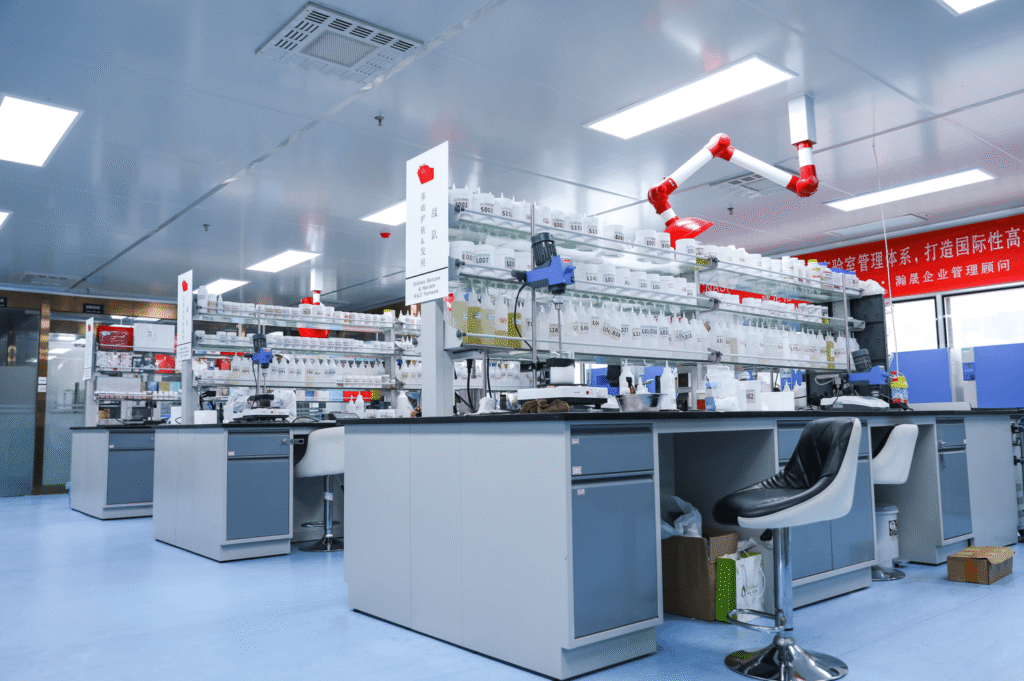
On the factory floor, the essentials are the same regardless of container: filling under controlled cleanroom conditions, precise fill weights, and batch-level quality control that covers appearance, texture, microbial limits, and retention samples for traceability.
Step 5: Timeline and Budget
A typical private label serum timeline looks like this:
- Formula sample: 3-7 days after your brief is confirmed
- Refinement rounds: 3-7 days per round
- Small trial batch: after sample approval, usually 300-500 units, in neutral bottle, with no packaging
- Formal production: 15-25 days after packaging materials are confirmed
- Shipping: 2-6 weeks depending on destination
The biggest budget levers, in rough order, are collagen type and raw-material grade (recombinant commands a premium over animal-derived), supporting actives, packaging complexity (airless pumps and ampoules cost more than standard bottles), and stability testing. Ask for a fully itemized quote — formula, raw materials, packaging, testing, and freight — so you can compare factories fairly.
How to Choose a Manufacturer for Your Recombinant Collagen Serum
Use this checklist when evaluating factories:
- GMP-certified, dust-controlled facility with an in-house R&D lab and real experience with protein-based actives
- Established biotech supply relationships — a partner who can source fermentation-derived recombinant collagen and provide certificates of analysis, not just animal-derived material
- A stated small-batch policy — trial orders in neutral bottles with no packaging should be welcome, not hidden
- In-house stability and QC, with batch retention and traceability
- Honest conversations about molecular weight and claims — a partner who explains what a collagen serum can and cannot do, rather than promising dermal regeneration
- Export experience to your target market, such as North America or Southeast Asia
You are choosing a partner for the next few years of your brand. The factory that treats your 300-unit serum trial as seriously as a 30,000-unit order is the one that will serve you best as you grow.
Frequently Asked Questions
What is the minimum order for a private label recombinant collagen serum?
Formal production orders for bottled serums typically start at 3,000-5,000 units, depending on format and packaging. Before that, you can run a small trial batch of 300-500 units, in neutral bottle, with no packaging.
Can I start with a small batch trial order first?
Yes. Many manufacturers will not support small orders, but MoCelie built its model around growing brands. Start with 300-500 units, in neutral bottle, with no packaging, test with real customers, and scale your formal order once demand is confirmed.
How fast can I receive a recombinant collagen serum sample?
Custom samples are typically ready in 3-7 days after your formula brief is confirmed.
Does recombinant collagen qualify as vegan?
Yes. Because it is produced through microbial fermentation — not extracted from animal tissue — recombinant collagen is compatible with vegan and cruelty-free brand positioning.
What distinguishes Type I from Type III collagen in practice?
Type I forms the thick structural fibers that give adult skin its firmness and density. Type III is finer and more elastic — it dominates in young skin and drops off rapidly with age. Many brands combine both to address firmness and elasticity in one product.
Can I formulate recombinant collagen alongside retinol or peptides?
Yes. Collagen pairs naturally with peptide complexes, hyaluronic acid, Pro-Xylane, and ginsenosides. When it comes to retinol or other potent actives, the formulation should undergo thorough compatibility and stability validation. Your lab should handle those tests as part of the development process.
What can I honestly claim about a topical collagen serum?
Surface hydration, barrier support, and film-forming protection are well-supported benefits for cosmetic collagen serums. If you want to make claims about dermal collagen production, that requires clinical data — and for most cosmetic brands, the hydration-and-barrier story is both simpler to defend and more aligned with what consumers actually feel.
How long does private label serum production take?
Formal production typically takes 15-25 days after packaging materials are confirmed at the factory, plus shipping time to your market.
Ready to Launch Your Recombinant Collagen Serum?
MoCelie is a leading skincare manufacturer in sensitive-skin repair, acne-prone skin recovery, and anti-aging care in China. Our 15-person in-house R&D team develops new formulas together with Peking University, Guangdong Pharmaceutical University, and Southern Medical University, as well as the Chinese Academy of Sciences’ Zhuhai Institute and OuZheng Research Institute. We operate from an 11,000 m² facility with over 200 staff under GMPC and ISO 22716 certification — and our lab specializes in high-potency, sensitive-skin-friendly serum formulas, ready to launch your recombinant collagen serum from sample to full production. Contact us to request a sample and a detailed quote.
Related products: Pro-Xylane Firming & Youth-Restoring Serum · Sheet Masks Private Label
Related guides: What Is Pro-Xylane in Skincare? · Pro-Xylane Serum & Ampoule Private Label Guide · PDRN Serum Private Label Guide · Pro-Xylane Cream Private Label Guide