What Is Pro-Xylane in Skincare? The Patent-Expired Anti-Aging Ingredient Explained
A jar of anti-aging cream that once cost hundreds of dollars now has shelf neighbors built around the same core molecule at a fraction of the price. The ingredient behind that shift is Pro-Xylane (玻色因) — chemically, hydroxypropyl tetrahydropyrantriol, a xylose-derived active that spent years as a premium-house exclusive. If you have been reading about “patent expiry” and wondering what it means for your brand, this guide explains the ingredient, why it matters now, and what to check before you formulate with it.
Why Everyone Is Talking About Pro-Xylane Right Now
The short answer is timing. Pro-Xylane was developed inside L’Oreal’s labs, where researchers were inspired by xylose from European beech trees, synthesized more than 200 derivatives, and selected the molecule now known as Pro-Xylane. The first patent application appeared in 2000, and for roughly two decades the molecular structure was effectively controlled by one company.
That exclusivity ended when the core synthesis patents completed their term around 2019-2020. The exact date is worth getting right: some online stories point to 2023-2026, but most sources place the expiry of the core synthetic route at 2019-2020. Once the patent wall fell, compliant raw-material suppliers began producing the same chemical structure — hydroxypropyl tetrahydropyrantriol — and the price of the ingredient dropped by roughly an order of magnitude. In China, where formulation activity is easy to track through public filing data, nearly 3,000 Pro-Xylane-containing products were filed with the NMPA in 2020 alone.
What this means for brands is simple: the ingredient is no longer a luxury-house exclusive. It is now an accessible, high-demand active at the same stage retinol, niacinamide, and hyaluronic acid passed through before becoming everyday staples.
What Pro-Xylane Actually Is
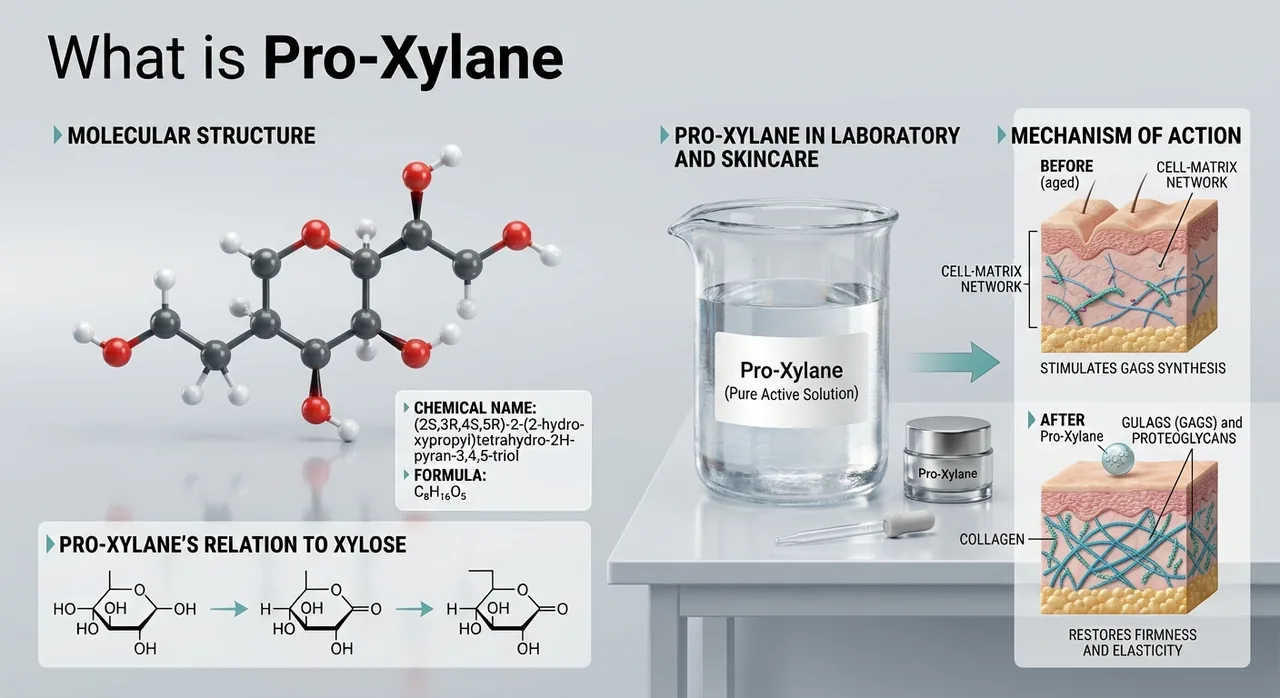
Pro-Xylane belongs to a family of sugar-derived actives called C-xylosides. It is water-soluble, relatively small, and unusually gentle compared with classic anti-aging actives. Rather than aggressive exfoliation or retinoid signaling, it works by supporting the skin’s own structural building blocks over time — which is why it is often described as a “slow and steady” ingredient rather than a fast-acting one.
One note for accuracy: “Pro-Xylane” remains a trademark associated with L’Oreal products. Independent suppliers sell the same chemistry under its INCI name, hydroxypropyl tetrahydropyrantriol. A product using the same structure is not a copy of any brand’s formula — formulation, delivery, and texture are where products actually differ.
How Pro-Xylane Works on Skin
In plain terms, Pro-Xylane acts like a “xyloside promoter.” It supports the skin’s production of glycosaminoglycans (GAGs), the water-attracting molecules that help the dermis hold volume and moisture. When GAG and proteoglycan levels are supported, the dermal-epidermal junction — the layer where skin gains structure and firmness — is better maintained, and skin looks plumper and more supple.
In practical terms, the commonly cited effects are:
- Plumping and hydration. By supporting GAG and hyaluronic acid levels, it helps skin retain moisture from within, which contributes to a smoother, fuller look.
- Firmness support. Healthier GAG and proteoglycan support is associated with a more resilient, firmer-looking complexion.
- Gentle anti-aging. Unlike peeling or irritating actives, Pro-Xylane is considered well tolerated, which makes it suitable for sensitive skin and for consumers who cannot use retinol.
- A helping hand for other actives. As a mild non-ionic, ether-type molecule, it can help other active ingredients disperse evenly and penetrate the stratum corneum slightly more effectively.
The “30%” Problem: How to Read a Pro-Xylane Label
Here is the most confusing part of the ingredient, and the most important to understand before you buy or formulate: the percentage on the label is rarely the percentage of pure active.
Many products advertise “30% Pro-Xylane.” In most cases that number refers to the amount of a Pro-Xylane solution added to the formula — a mixture that also contains water, solvents, and thickeners. Third-party analyses commonly estimate that a classic “30% Pro-Xylane” cream corresponds to roughly 9-11% of the pure active, hydroxypropyl tetrahydropyrantriol. When a major house launched an upgraded “50PX” version, independent estimates put the pure-active equivalent at roughly 15%. These are estimates, not official disclosures, but they explain the gap between label numbers and reality.
What should actually guide you:
- Check the ingredient order. Pro-Xylane should appear in the first part of the INCI list, not buried near the bottom among trace ingredients. Position in the list is more honest than a large percentage on the front of the jar.
- Ask what the percentage refers to. If a supplier or brand claims “30%,” ask whether that means the raw solution or the pure molecule.
- Judge the formula, not just the dose. An effective Pro-Xylane product needs a stable emulsion, a pleasant texture, and actives that work together. Typical effective levels start above roughly 3% of the pure active — above that, formulation quality matters more than stacking a higher number.
Pro-Xylane vs Retinol vs Peptides: Who Should Choose What
| Active | Main approach | Speed & feel | Best fit |
|---|---|---|---|
| Retinol / retinoids | Directly supports cell turnover and collagen-related renewal | Faster to show visible change; can cause dryness and irritation, needs gradual tolerance | Customers comfortable with stronger actives and an adjustment phase |
| Pro-Xylane | Supports GAG production for plumpness, hydration, and firmness | Gentler and slower-building; minimal irritation | Sensitive, reactive, or retinol-averse customers; “calm anti-aging” positioning |
| Peptides | Signal-like molecules that support collagen-related processes | Moderate; layers well with other actives | Brands building a multi-ingredient anti-aging story |
The three are not competitors in a routine — they are often combined. Pro-Xylane is particularly valuable as the gentle foundation of an anti-aging line because it can be used daily, including by sensitive-skin customers and those looking for soothing care after procedures.
How Strong Is the Evidence?
Honesty is part of good marketing. Most Pro-Xylane clinical work comes from within the developer’s research program plus in-vitro studies, with fewer large independent trials than retinol has accumulated. The evidence level is generally considered solid but more limited — think of it as “well-studied enough to trust, not as deeply documented as retinol.” Long-term use, not a single jar, is what makes the difference: six-month observations comparing a Pro-Xylane cream with a control cream have reported better outcomes for skin elasticity, dermal thickness, and fine lines on the Pro-Xylane side.
Is Pro-Xylane Safe for Sensitive Skin?
Pro-Xylane has a strong safety profile for a cosmetic active. It is considered well tolerated by most skin types, is frequently positioned for sensitive skin, and is generally regarded as safe for use during pregnancy (though specific situations should be discussed with a healthcare professional). As with any ingredient, isolated allergic reactions are possible but appear to be rare. For brands, this safety profile is a genuine advantage: a “gentle anti-aging” claim that works for sensitive and post-procedure customers is much easier to defend than a retinol-style claim.
Frequently Asked Questions
What is Pro-Xylane?
Pro-Xylane (玻色因) is the brand-era name for hydroxypropyl tetrahydropyrantriol, a xylose-derived active that supports GAG production for plumpness, hydration, and a firmer-looking complexion.
Is Pro-Xylane the same as the ingredient in expensive creams?
The chemical structure is available from multiple suppliers now that the core patents have expired. Independent products use the same molecule but their own formulas — they are not copies of any specific brand product.
How much Pro-Xylane do I actually need?
Meaningful levels typically start above roughly 3% of the pure active. A “30%” label often means a 30% solution, equivalent to roughly 9-11% pure active.
Pro-Xylane or retinol?
Retinol acts faster but irritates more; Pro-Xylane is gentler and better for sensitive skin. Many brands use both — retinol for consumers who tolerate it, Pro-Xylane as the daily, irritation-free layer.
Can Pro-Xylane be combined with peptides or PDRN?
Yes. Because it works on GAG support rather than exfoliation, Pro-Xylane layers naturally with peptides, collagen, PDRN, and hyaluronic acid in multi-path anti-aging formulas.
How long until results appear?
Pro-Xylane is a gradual ingredient. Consistent daily use over weeks to months — not a single application — is how it supports visible changes in texture, plumpness, and fine lines.
Ready to Formulate a Pro-Xylane Product?
The patent-expiry window has turned Pro-Xylane from an exclusive premium ingredient into one of the smartest formulation opportunities of the moment. MoCelie is a leading skincare manufacturer in sensitive-skin repair, acne-prone skin recovery, and anti-aging care in China. We have a 15-expert R&D team and joint research with Peking University, Southern Medical University, Guangdong Pharmaceutical University, Chinese Academy of Sciences (Zhuhai) & OuZheng Research Institute — and we produce from an 11,000 m² facility with over 200 staff under GMPC and ISO 22716 certification.
Tell us your product concept — a Pro-Xylane cream, serum, or ampoule — and we will help you plan the formula, honest percentage basis, packaging, and timeline. For brands across the globe, the first order is always welcome — contact us to request a sample and a detailed quote.
Related guides: Pro-Xylane Cream Private Label Guide · Pro-Xylane Serum & Ampoule Private Label Guide · What Is PDRN in Skincare? · PDRN vs Peptides