How Is PDRN Skincare Made? A Complete Manufacturing Guide for Brands
You have decided to launch a PDRN product. The ingredient is trending, the demand is real, and you have a brand story in mind. But before you sign with a manufacturer, you should understand one thing first: how is PDRN actually made?
The answer matters more than you think. The way PDRN is sourced and produced affects your cost, your claims, your stability, and even the story you tell your customers. This guide answers the questions every brand founder asks before manufacturing PDRN skincare – from raw material to finished product.
What Is PDRN Made From?
PDRN (polydeoxyribonucleotide) is a DNA-derived active, and today there are three main ways to produce it:
- Salmon-derived PDRN. The original route. PDRN is extracted from salmon DNA – this is the ingredient behind Korea’s famous “salmon skincare” trend. It has the strongest consumer recognition, but it is an animal source, which raises vegan and allergen questions.
- Fermented PDRN. Produced by microbial fermentation, for example using halomonas bacteria. No animals involved, fully scalable, and the route behind major launches such as Lancome’s PDRN technology.
- Recombinant PDRN. Made with biotechnology to produce precise, repeatable DNA sequences. This is the newest route and the one used by brands like Clinique for their PDRN line. It offers the highest batch-to-batch consistency and works well for premium, science-forward positioning.
Each route is legitimate – but they are not interchangeable. Choosing the right one depends on your brand story and budget.
Which PDRN Source Should Your Brand Choose?
| Source | How it’s made | Best for | Watch out for |
|---|---|---|---|
| Salmon-derived | Extracted from salmon DNA | The classic “salmon skincare” story; strong consumer recognition | Animal source; vegan and allergen questions; batch consistency depends on the supplier |
| Fermented | Microbial fermentation (e.g., halomonas) | Animal-free, scalable supply; mid-range pricing | Less consumer familiarity; you need to explain it simply |
| Recombinant | Biotech production of precise sequences | Premium, clean, science-led positioning; maximum consistency | Higher raw-material cost; a newer story to tell |
How to choose:
- If your customers already search for “salmon skincare,” salmon-derived PDRN gives you instant recognition.
- If vegan and cruelty-free positioning matters, choose fermented or recombinant PDRN.
- If you want a premium, lab-led brand, recombinant is the easiest story to defend.
Your manufacturer should be able to supply any route and explain the trade-offs honestly. If a factory only pushes one source without asking about your positioning, that is a red flag.
How Is PDRN Extracted and Purified?
Regardless of the source, the production process follows the same logic: obtain the DNA, purify it, and control its quality.
- For salmon-derived PDRN: the raw material goes through extraction, then multiple purification steps to remove proteins and other impurities, then concentration and molecular-weight control.
- For fermented PDRN: bacteria are cultured in controlled conditions, and the PDRN is recovered from the fermentation broth and purified.
- For recombinant PDRN: engineered cells produce the desired sequence, which is then purified to a high degree of consistency.
The critical part is not the first step – it is everything after: purity, molecular weight, and batch-to-batch consistency. Always ask for the certificate of analysis (COA) for each batch, and confirm your manufacturer can trace the raw material back to its supplier.
Why Does PDRN Skincare Cost More?
PDRN products sit at a higher price point than regular moisturizers for a simple reason: the raw material. High-quality PDRN is expensive to source or produce, and purification adds significant cost. On the shelf, the difference shows up in your ingredient cost and therefore your pricing.
Two practical notes:
- PDRN is typically used at a low percentage in formulas, so the ingredient cost is manageable – it is not like filling a bottle with gold.
- Ask for an itemized quote so you can see exactly how much of the price is raw material, packaging, and labor. A manufacturer who cannot explain the cost breakdown is hiding something.
What Makes PDRN Hard to Formulate?
Here is where the experience of the factory really matters. PDRN is a nucleic acid, which means it is sensitive to heat, extreme pH, and enzymatic breakdown. Get the formulation wrong, and your active can degrade before it reaches the customer’s shelf.
A good manufacturer protects PDRN through:
- Adding the active at the cooling stage of production, not at high temperature
- Choosing a pH range and preservative system that keeps the molecule stable
- Using chelating agents to reduce degradation
- Specifying airless or light-protected packaging where needed
- Running stability tests across temperature ranges and time periods
This is also why compatibility testing matters. PDRN works well alongside many actives (peptides, hyaluronic acid), but not every combination is safe. A factory with an in-house lab should be able to test compatibility before you commit to a formula.
What Does the Manufacturing Process Look Like From Order to Delivery?
Here is the step-by-step flow you can expect from a professional PDRN manufacturer:
- Brief and concept. You share your product idea, target audience, and positioning.
- Formula development and sample. The lab develops your formula and sends a sample – typically within 3-7 days.
- Stability and compatibility testing. The formula is tested for stability and safety before you approve it.
- Sample approval. You approve the final sample, texture, and scent.
- Bulk production. Emulsifying, filling, and packaging – usually 2-4 weeks.
- Quality control. Every batch is tested, and you receive the certificate of analysis.
- Shipping and documentation. Goods ship with the documents you need for your market (COA, MSDS, export paperwork).
In total, plan for roughly 6-12 weeks from approved sample to goods on the water, depending on packaging and destination.
What Are the MOQs and Can I Start Small?
Minimum order quantities depend on packaging: soft tubes generally start at around 10,000 units (that is the threshold for running the line), while bottles typically start at 3,000-5,000 units.
If that feels too large for a first test, ask about small-batch options. Not every factory supports them – we do, because we want to grow together with our partners. A small first order lets you validate your formula and your market before committing to a bigger run.
FAQ
Is PDRN vegan?
Salmon-derived PDRN is an animal source. If vegan or cruelty-free positioning matters, choose fermented or recombinant PDRN, which are produced without animals.
Is PDRN suitable for sensitive skin?
PDRN is commonly formulated for sensitive and post-treatment skin. As with any active, patch testing is recommended, and the final formula should be developed around your target audience.
Can PDRN be combined with other actives?
Yes. PDRN pairs well with peptides, hyaluronic acid, and soothing ingredients. Not every combination is compatible, so have the lab run compatibility tests before finalizing the formula.
How long does PDRN manufacturing take?
Samples typically take 3-7 days, bulk production 2-4 weeks after approval, and shipping 2-6 weeks depending on your destination.
How do I know the PDRN in my product is high quality?
Ask for the batch certificate of analysis, raw-material traceability, stability data, and independent test results. These documents are the real proof of quality.
Do you provide regulatory documents?
Yes – we provide certificates of analysis, material safety data sheets, stability data, and export documentation, and we can support you with market registration such as FDA establishment registration and EU CPNP notification.
Ready to Manufacture PDRN Skincare?
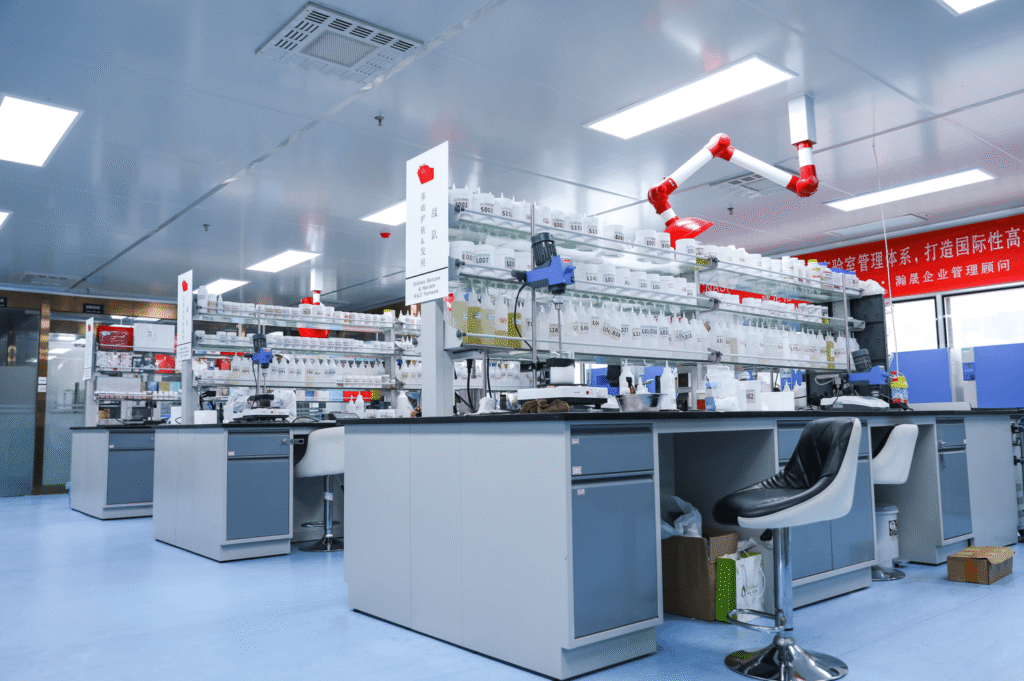
MoCelie is a skincare manufacturer in Guangzhou, China, specializing in OEM/ODM private label production for brands in North America and Southeast Asia. Our product range covers masks, creams, lotions, serums, and cleansers, and we formulate with high-demand actives including PDRN, collagen, Pro-Xylane, ginsenosides, peptides, and retinol.
If you are planning a PDRN launch, tell us your concept and we will guide you through sourcing, formulation, and production. Contact us to start your PDRN project. You may also want to read PDRN Lotion Private Label: The Complete Guide for Skincare Brands for the full launch checklist.