PDRN vs Collagen vs Snail Mucin: Which Active Should Your Skincare Brand Choose?
If you are planning a skincare launch, you have probably compared PDRN, collagen, and snail mucin at some point. All three are trending actives with strong consumer recognition – but they work in very different ways, target different skin concerns, and tell different stories on your label. This guide compares them head-to-head so you can decide which active, or which combination, fits your brand positioning.
What Is PDRN?
PDRN (polydeoxyribonucleotide) is a DNA-derived active made of DNA fragments, originally sourced from salmon. In skincare, it supports the skin’s natural renewal processes in two ways: it supplies nucleotides, the building blocks skin cells use when making new DNA, and it activates the A2A receptor, which supports collagen and elastin activity, healthy microcirculation, and a balanced inflammatory response. You can read more about what PDRN is and how it works.
Today PDRN is produced in three ways – salmon-derived, microbial fermentation, and recombinant biotechnology – and each route has different cost and positioning implications, which we explain in our PDRN manufacturing guide. Market momentum is strong: PDRN has moved from medical aesthetics into everyday serums, lotions, and masks, and more than 30 beauty brands have already launched PDRN products.
What Is Collagen?
Collagen is the most abundant protein in human skin, making up about 75% of skin weight and providing structure, strength, and elasticity. Human skin contains 29 known types of collagen; type I (structure) and type III (elasticity and repair) are the most relevant for cosmetics. Collagen production naturally declines starting in your 20s, by roughly 1.5% per year, and the loss accelerates around age 25-30 – which is why collagen remains one of the most talked-about anti-aging ingredients.
In cosmetics, collagen appears mainly in two forms: hydrolyzed collagen (broken into smaller peptides for easier penetration) and recombinant collagen (produced by biotechnology with a structure identical to human collagen). One important technical note for brands: topical collagen faces a penetration challenge, because molecules above roughly 30 kDa struggle to pass the skin barrier. This is why “does topical collagen work?” is such a common question – and why formula design matters.
What Is Snail Mucin?
Snail mucin (snail secretion filtrate) is the gel-like substance secreted by snails, popularized by Korean beauty brands. It contains a mix of glycoproteins, hyaluronic acid, glycolic acid, and allantoin, which makes it hydrating, soothing, and supportive of the skin barrier. Snail mucin is best known for a smooth, plumping effect and is a long-time favorite in hydration and sensitive-skin formulas.
PDRN vs Collagen vs Snail Mucin: Quick Comparison
| Aspect | PDRN | Collagen | Snail Mucin |
|---|---|---|---|
| What it is | DNA fragments (nucleotides) | Structural protein | Snail secretion filtrate |
| Main mechanism | Supports the skin’s own renewal processes | Provides structural support; peptide forms send signals | Hydrates, soothes, supports the barrier |
| Best known for | Renewal, barrier support, calming redness | Firmness, elasticity, structure | Hydration, soothing, plumpness |
| Consumer recognition | Rising fast (“salmon skincare”) | Very high, classic | High (K-beauty classic) |
| Brand story | Science-led, regenerative | Structural, timeless | Natural, gentle |
| Typical usage | Serums, lotions, masks | Creams, serums, masks | Serums, creams, essences |
How Each Active Works on the Skin
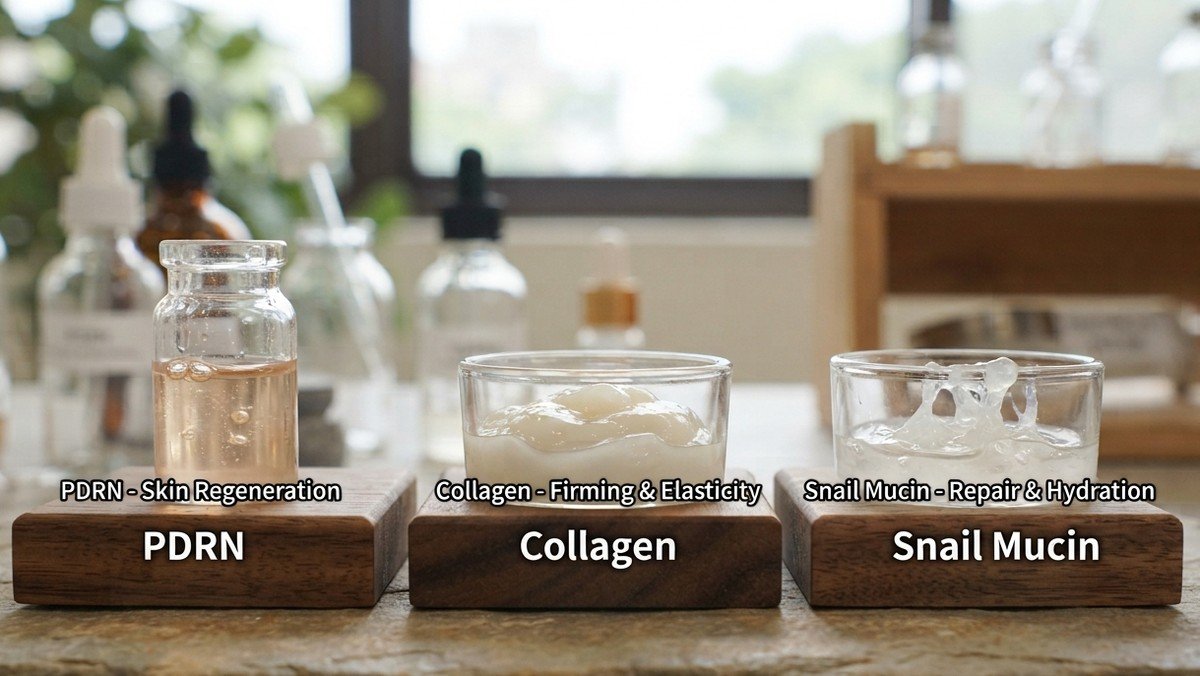
PDRN: supports the skin’s own repair system. PDRN is a “helper” ingredient. It supplies building blocks for cell renewal and activates signaling that supports the environment where collagen and elastin are produced. It also supports healthy microcirculation and a balanced inflammatory response, which is why it appears in formulas for sensitive and post-treatment skin. Like most actives, it works gradually with consistent daily use.
Collagen: building blocks and signals. Topical collagen provides amino acids and, in peptide form, sends signals that support the skin’s collagen network. Its main limitation is penetration: large collagen molecules struggle to pass the barrier, so formula technology (smaller peptides, delivery systems) matters more than raw concentration.
Snail mucin: hydration plus soothing. Snail mucin is rich in humectants and soothing compounds, making it excellent for moisture, comfort, and a smoother-looking texture. It is less about signaling and more about delivering a soft, hydrated, comfortable skin feel.
Which Active Is Best for Each Skin Concern?
| Skin concern | Best choice | Why |
|---|---|---|
| Anti-aging and firmness | PDRN + collagen | PDRN supports renewal; collagen provides structural support |
| Sensitive or reactive skin | PDRN or snail mucin | Both are gentle; PDRN supports calm, snail mucin soothes and hydrates |
| Dryness and dehydration | Snail mucin | Humectant-rich, immediate comfort |
| Post-treatment recovery | PDRN | Commonly used in aftercare formulas for its calming profile |
| Acne-prone skin | PDRN | Supports a balanced inflammatory response without heavy texture |
PDRN vs Collagen: The Anti-Aging Showdown
Think of it this way: collagen is about “external support” – giving skin the structure it visibly needs – while PDRN is about “internal renewal” – supporting the skin’s own ability to maintain itself. They are not rivals so much as two halves of the same story, which is why many premium formulas combine both. For brands, the choice depends on positioning: collagen is a timeless, easy-to-explain story; PDRN is a newer, science-led story with less market saturation.
PDRN vs Snail Mucin: Renewal vs. Soothing
Snail mucin excels at hydration and immediate comfort, with a strong K-beauty heritage that consumers already understand. PDRN offers a deeper, mechanism-driven story around renewal and barrier support, with a growing story in Western markets. Brands targeting sensitive-skin customers often start with snail mucin for its approachability, then add PDRN as a premium, science-led upgrade.
Can You Combine PDRN, Collagen, and Snail Mucin?
Yes. PDRN is generally compatible with collagen, snail mucin, peptides, and hyaluronic acid, and many functional formulas pair them deliberately – for example, a PDRN serum with collagen peptides for renewal plus structure, or a snail mucin cream with PDRN for hydration plus calm. As with any active combination, we recommend having your lab run compatibility and stability testing before locking the formula.
What Brands Should Consider Before Choosing
Market timing. Industry analysis suggests PDRN is still in its education phase, with the real consumer surge expected as home-care products scale up over the next one to two years. Brands that build a PDRN story now can own the category before it gets crowded – the same playbook that worked for hyaluronic acid.
Story and positioning. Collagen and snail mucin are already well understood by consumers, which makes them easy to sell but harder to differentiate. PDRN gives you a more distinctive, science-led story – and it pairs well with “salmon skincare” and regenerative beauty narratives that are gaining traction.
Cost structure. PDRN tends to carry a higher raw-material cost than snail mucin or standard collagen, but it is typically used at low percentages, so the finished-product cost impact is manageable. Ask your manufacturer for an itemized quote to compare honestly.
Compliance. Keep all three actives in cosmetic territory. Use “supports,” “maintains,” “calms,” and “helps maintain” – avoid “treats,” “repairs damage,” or anything medical. If you are launching in the US or EU, your manufacturer should provide the labeling and registration support you need.
Frequently Asked Questions
Is PDRN or collagen better for anti-aging?
They support aging skin in different ways: collagen provides structural support, while PDRN supports the skin’s own renewal processes. Many brands use both together for a fuller anti-aging story.
Is PDRN or snail mucin better for sensitive skin?
Both are gentle. Snail mucin is hydrating and soothing, while PDRN supports calm and barrier comfort – either can work; some formulas combine them.
Can PDRN be combined with collagen or snail mucin?
Yes, PDRN is generally compatible with both, plus peptides and hyaluronic acid. Ask your lab to run stability and compatibility tests before locking the formula.
Which active is best for a private label product?
It depends on positioning: PDRN for a premium, science-led launch; snail mucin for an approachable, hydration-first product; collagen for a timeless firmness story. Your manufacturer can help you decide based on your target market.
Why is PDRN skincare more expensive?
PDRN requires sophisticated production and purification (extraction, fermentation, or biotechnology), which raises raw-material cost. It is used at low percentages, though, so the impact on finished-product cost is manageable.
Ready to Launch a PDRN, Collagen, or Snail Mucin Product?
MoCelie is a skincare manufacturer in Guangzhou, China, specializing in OEM/ODM private label production for brands across the globe. Our in-house lab can help you choose the right active and formula for your market. Contact us to request a sample and a detailed quote.
Related guides: What Is PDRN in Skincare? · How Is PDRN Skincare Made? · PDRN Lotion Private Label Guide · Private Label Serums