PDRN for Anti-Aging: Supporting Fine Lines, Firmness, and Skin’s Natural Renewal
Walk down any anti-aging aisle and you will find the same story: retinoids to speed up cell turnover, peptides to send signals, vitamin C to defend against daily stress. These are proven tools, but they all share one assumption — that the skin can do more if it is pushed harder. PDRN offers a different starting point: instead of pushing, it supplies the raw materials that skin cells already use for renewal, so the skin can do its own work more comfortably over time.
Why Anti-Aging Skincare Needs a Different Kind of Active
Aging skin is not one problem; it is several at once. Fine lines appear where the skin becomes thinner and less plump. The look of firmness fades as the skin’s support structure changes over time. Radiance drops as surface cell renewal slows. And the skin itself becomes more sensitive to the very actives marketed to fix these issues — dryness, tightness, and reactivity are common complaints on retinol and acid routines.
The classic response has been “more active, more often.” But a growing number of formulators take the opposite view: aging skin does not always need more stimulation. Sometimes it needs better support — hydration, barrier comfort, and the building blocks that make renewal possible in the first place. That is the space PDRN occupies, and it is why the ingredient has moved from professional aftercare into everyday skincare.
How PDRN Supports Aging Skin
PDRN (polydeoxyribonucleotide) is a DNA-derived active made of nucleotide fragments. In skincare, it is best understood as a support ingredient rather than a “corrector.” The actions most relevant to anti-aging positioning:
- Supports the skin’s natural renewal cycle. Nucleotides are building blocks skin cells use as they renew. By supplying them topically, PDRN supports the environment in which the skin maintains normal, healthy renewal.
- Supports the skin’s own structural work. In professional and regenerative contexts, PDRN has a long history of supporting fibroblast activity — the cells associated with collagen and elastin production. Cosmetic PDRN products translate this into a “support from within” story about maintaining the look of firmness.
- Supports a smoother, more comfortable surface. PDRN is often paired with hydration and soothing ingredients, which helps skin look and feel smoother — an effect that makes fine lines appear softened over time.
- Gentle by design. Unlike retinoids or acids, PDRN is not an irritant-driven active. It fits routines for customers whose skin cannot tolerate constant resurfacing.
To be clear about what PDRN is not: it is not an exfoliant, it does not deliver an immediate “lift,” and it is not a substitute for sun protection. It is a gradual, supportive ingredient — one that makes an anti-aging routine more tolerable and more sustainable. For the basics of the ingredient, see our guide to what PDRN is in skincare.
PDRN vs Common Anti-Aging Actives
| Active | Main role | Texture and feel | How it pairs with PDRN |
|---|---|---|---|
| Retinol / retinoids | Support cell turnover and smooth the look of lines | Can be drying and irritating at first | PDRN adds comfort during the adjustment phase |
| Peptides | Support the skin’s natural signaling and structure | Lightweight, generally gentle | Natural companion; both are “support” actives |
| Vitamin C | Helps defend against environmental stress | Can tingle on sensitive skin | PDRN helps skin feel more comfortable around it |
| Topical collagen | Adds surface hydration and cushion | Rich, sometimes heavy | Different role: collagen hydrates, PDRN supports renewal |
| Hyaluronic acid | Attracts and holds water | Light to rich textures | Strong pairing: hydration plus renewal support |
| PDRN | Supports renewal, comfort, and the look of firmness | Lightweight, serum-friendly | Pairs with all of the above as the support layer |
Where PDRN Fits in an Anti-Aging Routine
Because PDRN is gentle and layers well, it can sit in almost any step of a routine. A simple framework for a brand to recommend:
| Time | Product type | Why |
|---|---|---|
| Morning | Gentle cleanser | Prepare the skin without stripping it |
| Morning | Vitamin C or antioxidant serum | Defense layer for the day |
| Morning | PDRN serum or essence | Support layer; helps skin feel comfortable |
| Morning | Moisturizer + SPF | Protect and seal |
| Evening | PDRN serum | On “active-free” nights, as the main support step |
| Evening | Retinol or peptide cream (2–3 nights/week) | The resurfacing step, with PDRN as a buffer |
| Weekly | PDRN sheet mask or ampoule | A recovery ritual for stressed or tired skin |
Best Formats for Anti-Aging Products
- Lightweight serum or essence. The most common and easiest to layer under creams and SPF.
- Single-dose ampoule. Premium, travel-friendly, and easy to frame as a “recovery” treatment.
- Eye serum or cream. Fine lines around the eyes are a top concern; PDRN fits the gentle, hydrating profile eye products need.
- Sheet mask. A weekly comfort-and-support ritual, especially after a week of strong actives.
- Night cream or emulsion. PDRN as a base layer for the evening support step.
Formulation Tips for Brands
- Pair PDRN with hydration and peptides. Hyaluronic acid, glycerin, and peptide complexes reinforce the anti-aging story without competing with it.
- Keep it gentle enough to buffer retinoids. A formula that supports barrier comfort is easier to sell to customers who struggle with retinol irritation.
- Run stability testing. PDRN is generally stable and gentle, but verify pH, preservative, and compatibility with the other actives in your formula.
- Compliant claims that still sell. Use “supports the skin’s natural renewal,” “helps maintain the look of firmness,” “supports a smoother-looking surface,” and “comfortable around strong actives.” Avoid medical or dramatic wording such as “repairs wrinkles” or “restores collagen.”
What PDRN Does Not Do
Honesty is part of the story. PDRN will not erase deep lines overnight, and it will not produce the dramatic resurfacing results of a high-strength retinoid. It also cannot compensate for missing sun protection — daily SPF remains the single most important anti-aging step. PDRN works best as the consistent support layer in a routine built on sun protection, hydration, and (where tolerated) a resurfacing active. Brands that explain this positioning win trust, and trust converts.
Frequently Asked Questions
Does PDRN work for wrinkles?
PDRN is positioned as a support active for the look of fine lines: it supports the skin’s natural renewal and is typically formulated with hydration and soothing ingredients that help skin look smoother and more comfortable over time. It is not a medical treatment for wrinkles.
Is PDRN as strong as retinol?
They do different jobs. Retinol supports cell turnover and can produce visible resurfacing results, but it is also more irritating. PDRN is a gentle support ingredient — many brands use them together, with PDRN helping skin feel comfortable during retinol adjustment.
Does PDRN stimulate collagen?
In professional and regenerative contexts, PDRN has a history of use supporting fibroblast activity. In cosmetic products, brands describe this as “supporting the skin’s natural structural work” and pair PDRN with peptides and hydration. Cosmetic claims should avoid direct medical language.
Can PDRN be used with retinol and vitamin C?
Yes. PDRN layers well with both. A common routine uses vitamin C in the morning and retinol at night, with PDRN as a calming support step around them.
How long until customers see results?
PDRN is a gradual, maintenance-oriented active. Most brands set expectations of several weeks of consistent use, with the visible benefit showing up as improved comfort and a smoother, healthier-looking surface rather than an overnight change.
Is PDRN suitable for sensitive skin?
Yes — in fact, PDRN is widely used in sensitive-skin and post-procedure formulas because it is gentle. If your anti-aging line targets customers who cannot tolerate strong actives, a PDRN-led formula is a differentiated, lower-irritation option.
Ready to Launch a PDRN Anti-Aging Product?
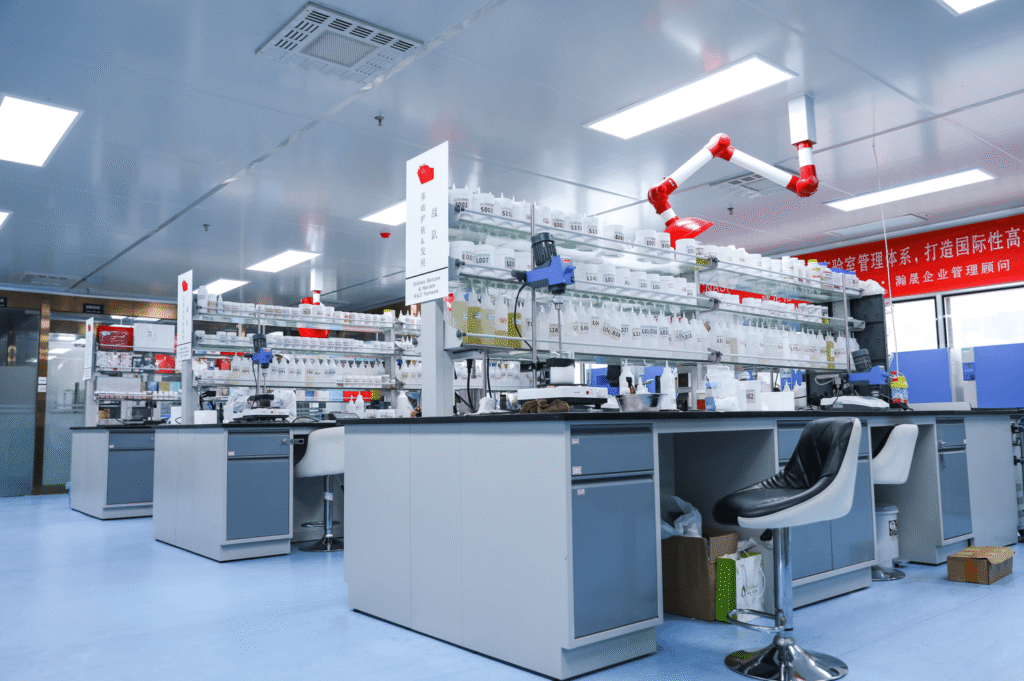
MoCelie is a leading skincare manufacturer in sensitive-skin repair, acne-prone skin recovery, and anti-aging care in China. Our 15-person in-house R&D team develops new formulas together with Peking University, Guangdong Pharmaceutical University, and Southern Medical University, as well as the Chinese Academy of Sciences’ Zhuhai Institute. We operate from an 11,000 m² facility with over 200 staff under GMPC and ISO 22716 certification — and our lab can help you develop a gentle, science-led PDRN anti-aging product from sample to full production. Contact us to request a sample and a detailed quote.
Related guides: What Is PDRN in Skincare? · How Is PDRN Skincare Made? · PDRN vs Peptides · PDRN Serum Private Label Guide · PDRN for Acne-Prone Skin